Logistic Growth


Applied Population Dynamics
WILD 5700/7700

Today in APD


The equation for logistic growth in discrete time.


The definition of density-dependent growth.


Basic properties of the model.


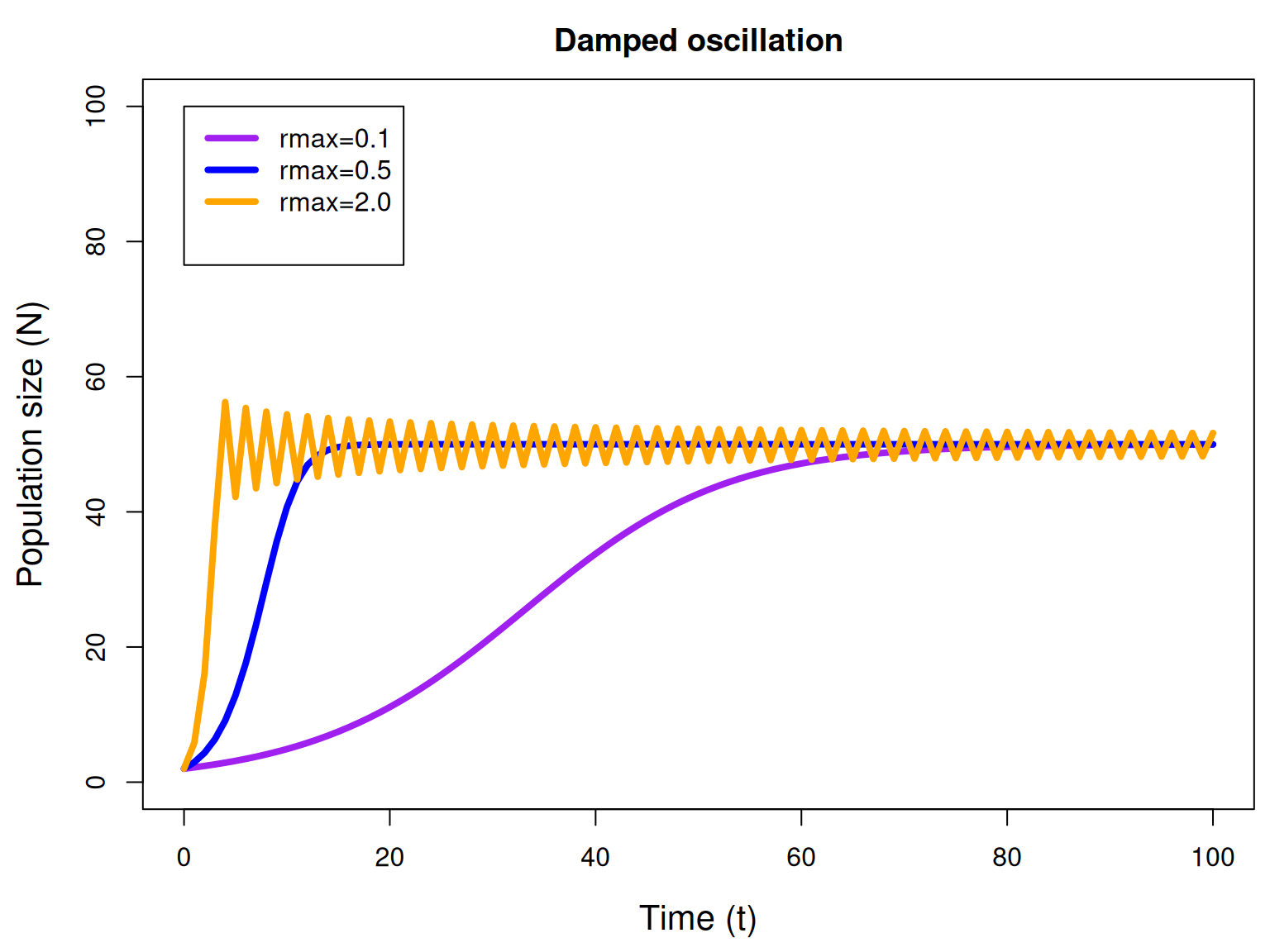
Strange behavior of the (discrete time) model, such as damped oscillations and chaos.

From Geometric to Logistic Growth

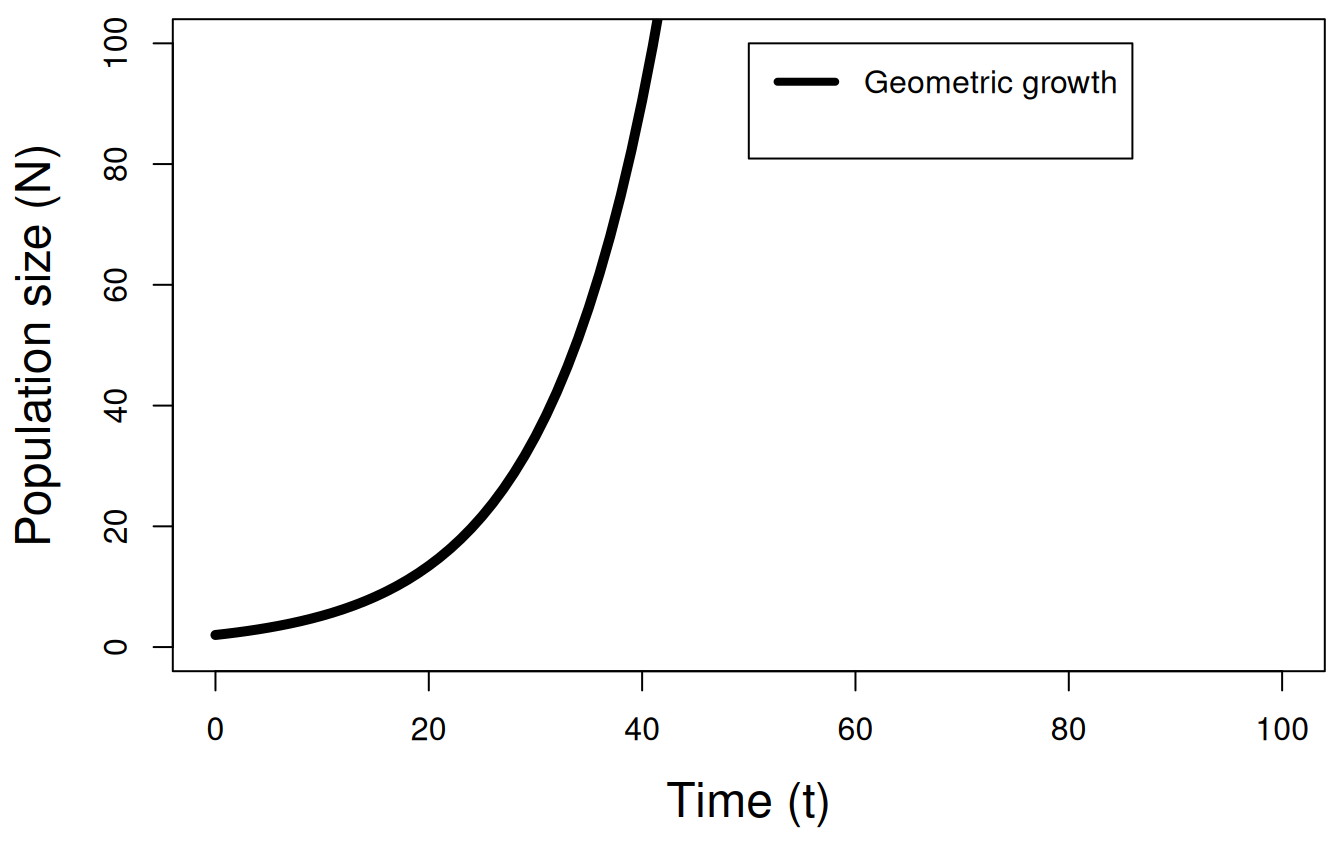
Geometric growth

\[N_{t+1} = N_t + N_tr\]

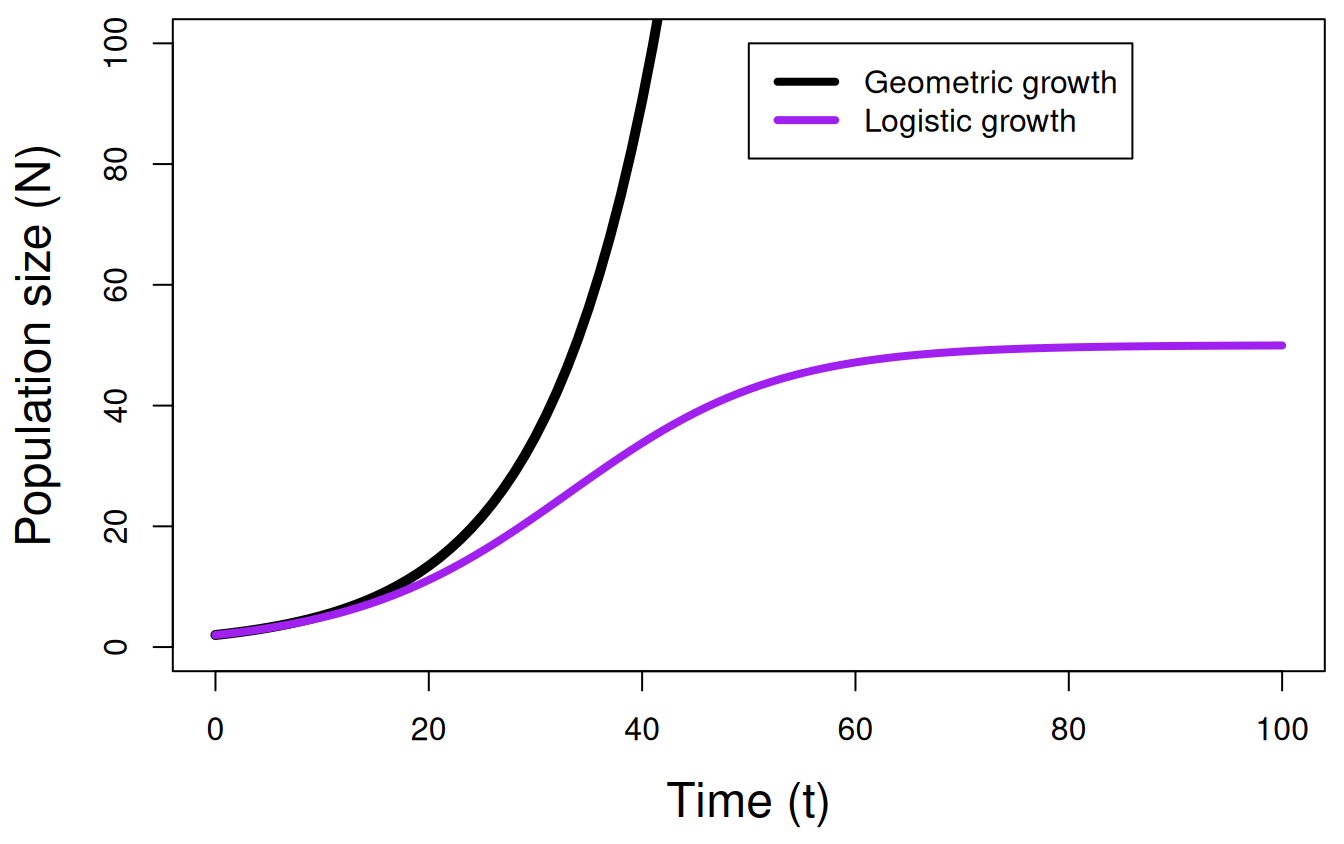
Logistic growth

\[N_{t+1} = N_t + N_t r_{max}\left(1 - \frac{N_t}{K}\right)\]

where

  • \(r_{max}\) is the growth rate when \(N_t\) is close to 0

  • \(K\) is the carrying capacity

Density-dependent growth


Logistic growth is an example of density-dependent growth.


Definition: Population growth rate is affected by population size (\(N\)).


Implications: Resources are limited and there is a carrying capacity.

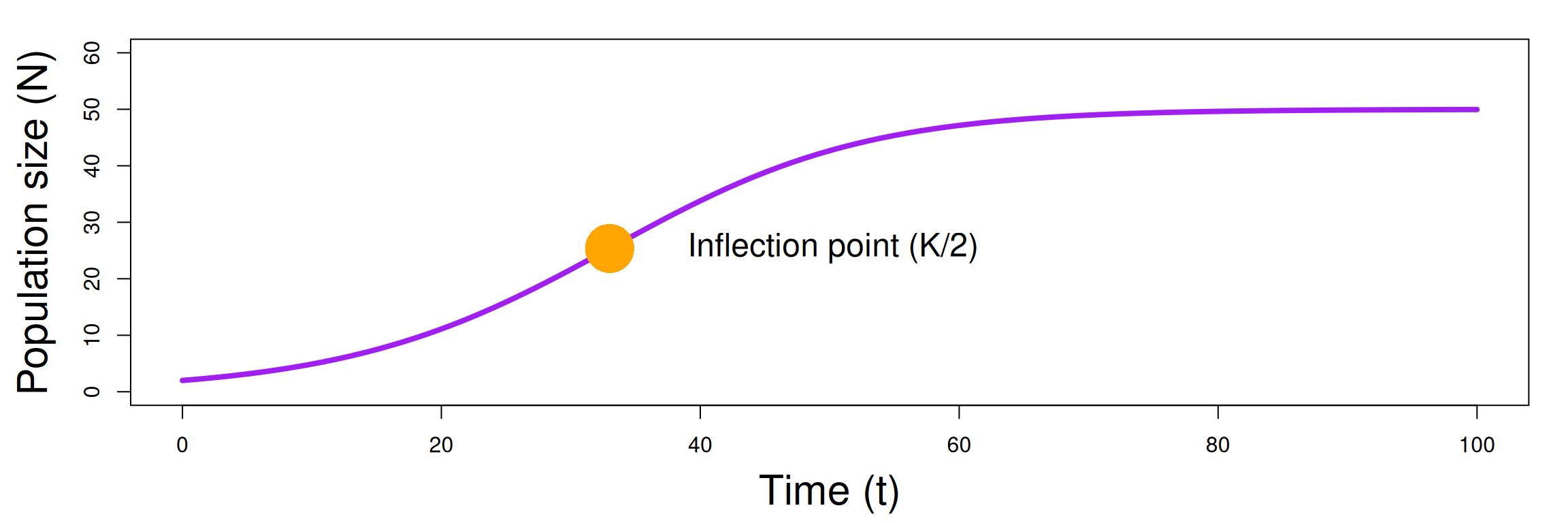
Graphical depiction

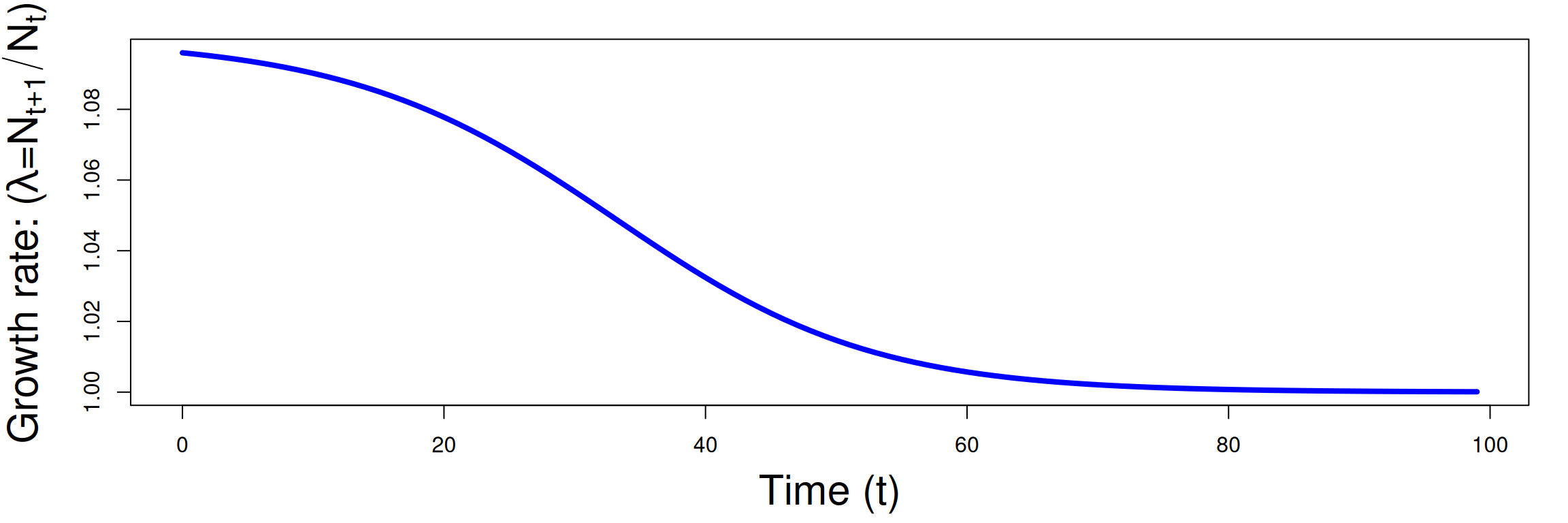
Growth rate

\[\lambda_t = N_{t+1}/N_t\]
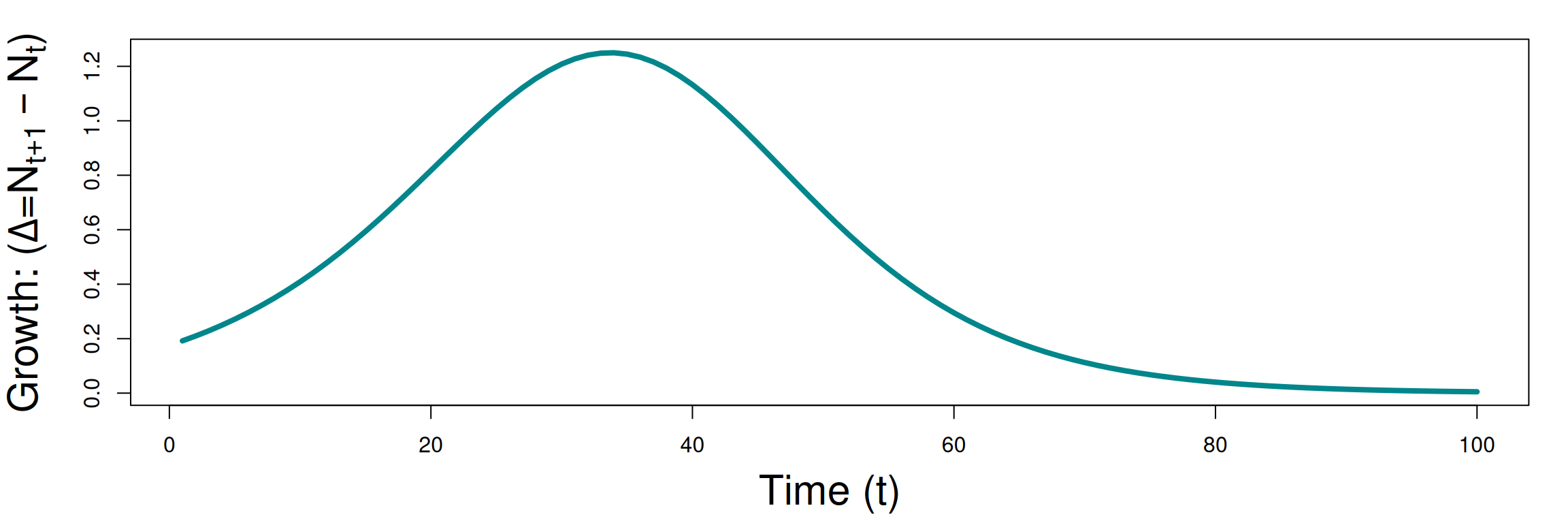
Growth

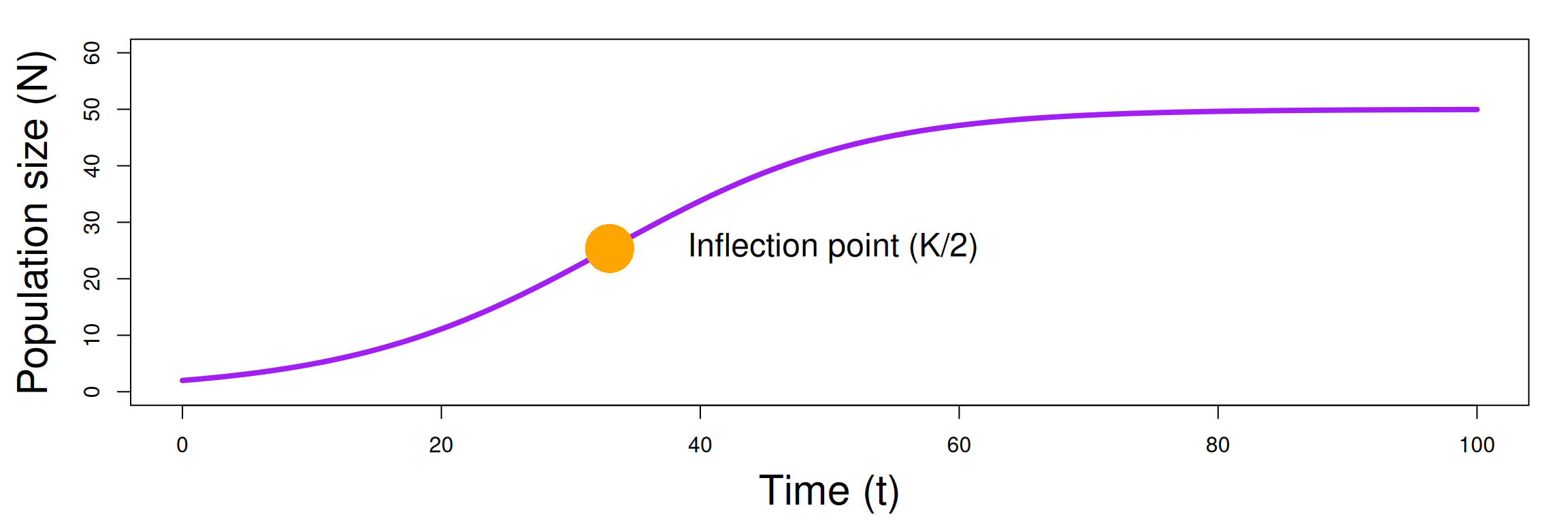
\[\Delta_t=N_{t+1}-N_t\]
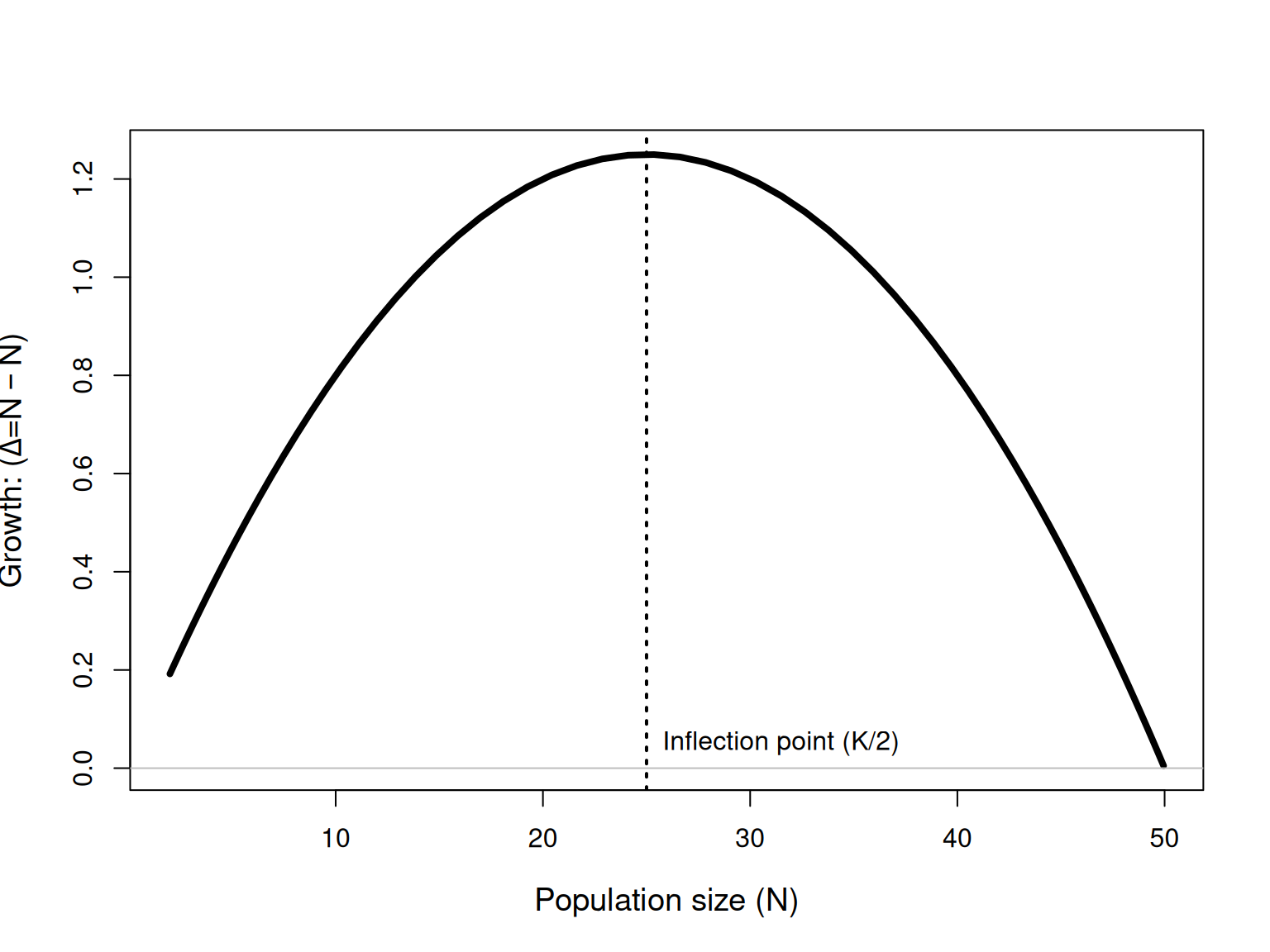
Growth as a function of \(N\)
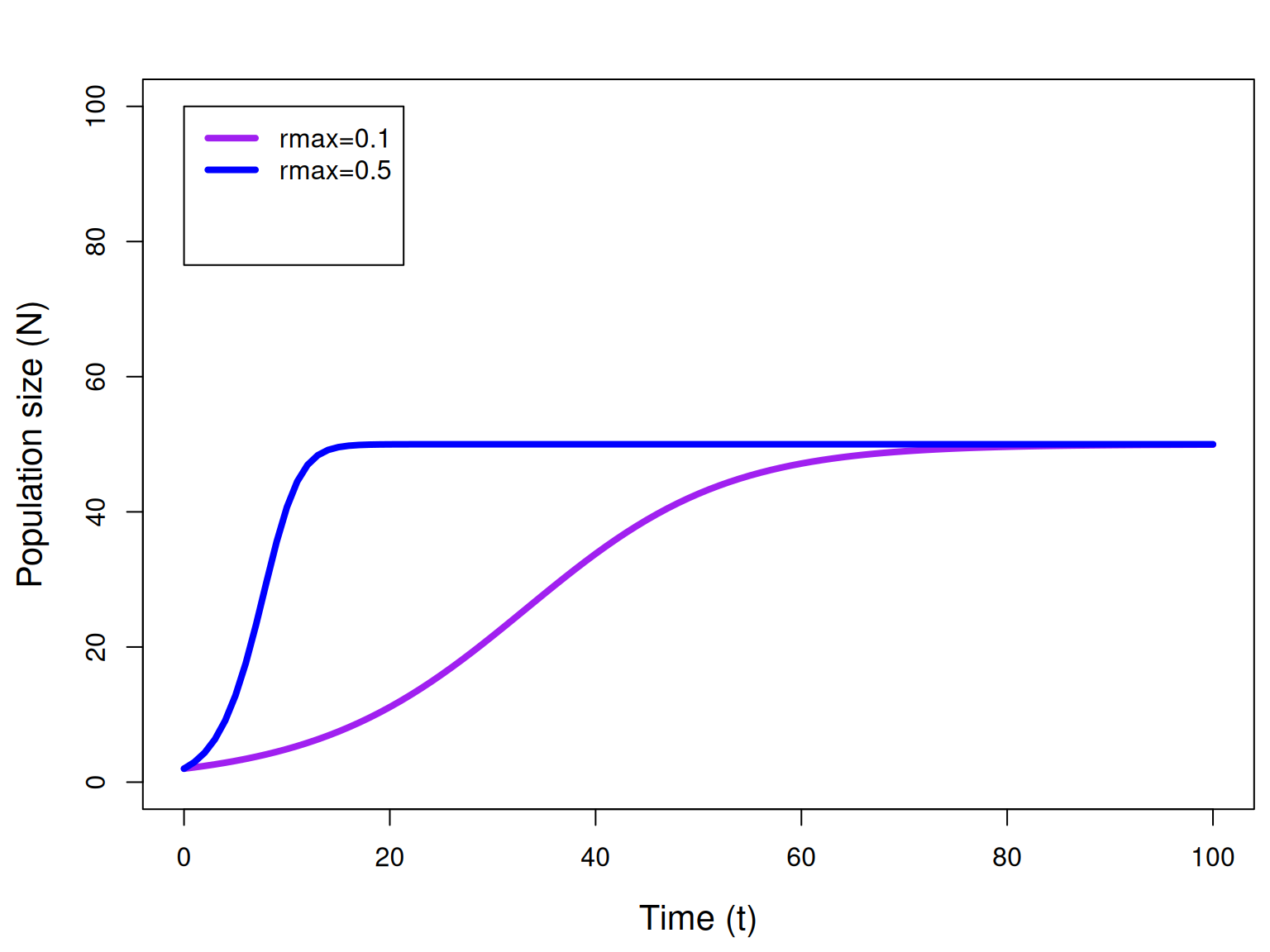
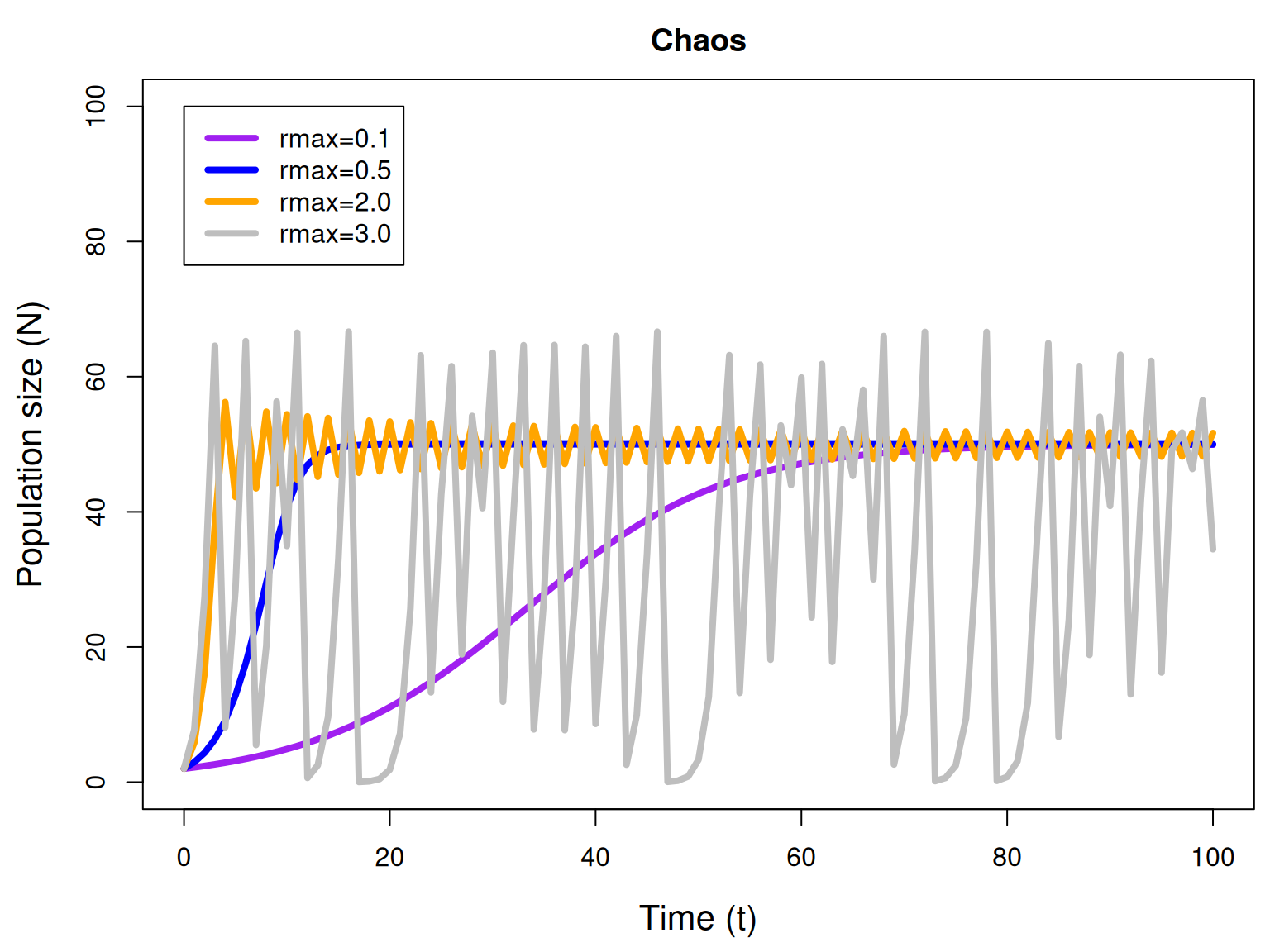
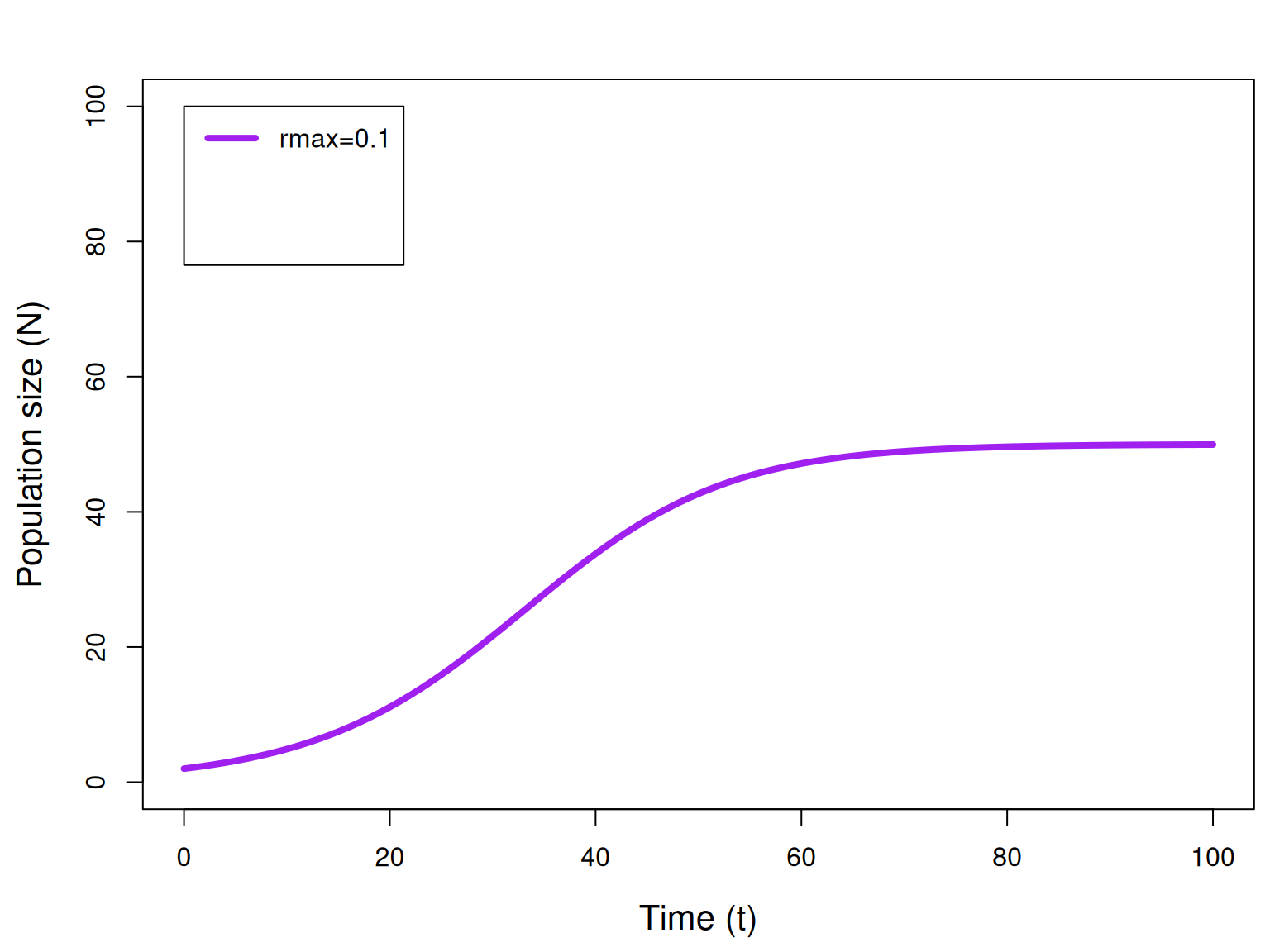
What happens when we change \(r_{max}\)?
Definitions


Overcompensation

Density-dependent response in which populations over- or under-shoot carrying capacity rather than approach it gradually.


Chaos

Highly variable deterministic dynamics that are extremely sensitive to small changes in parameters.

Assumptions of basic model

  • \(K\) and \(r_{max}\) are constant

  • No sex or age effects or other sources of individual heterogeneity

  • No time lags

  • No stochasticity

Does logistic growth occur in nature?

Fruit fly (Drosophila melanogaster) in the lab1
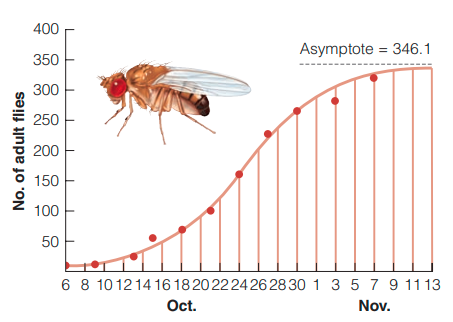
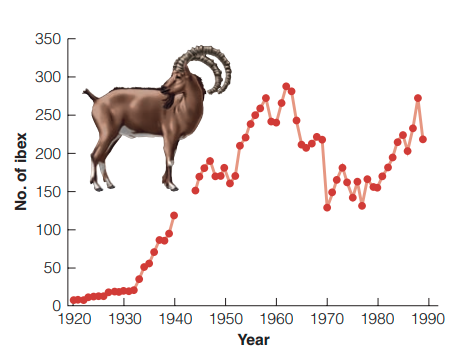
Does logistic growth occur in nature?

Ibex (Capra ibex) in Switzerland1
Summary

  • Logistic growth is a form of density-dependent growth

  • Growth rate (\(\lambda_t=N_{t+1}/N_t\)) declines as \(N\) approaches \(K\)

  • Growth (\(\Delta_t=N_{t+1}-N_t\)) peaks at \(K/2\) (the inflection point)

  • The model doesn’t include birth, mortality, and movement processes, but it can be derived from density-dependent birth and death rates.

  • But it does allow for complex dynamics that resemble patterns seen in nature.


Assignment

Read pages 32–36 in Conroy and Carroll.