Metapopulation models

Applied Population Dynamics (WILD 5700/7700)

Metapopulations


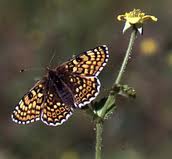
A metapopulation is a population of subpopulations linked by dispersal.


Properties

  • Subpopulations occur in discrete habitat patches.
  • The landscape “matrix” is not suitable for reproduction.

Motivation

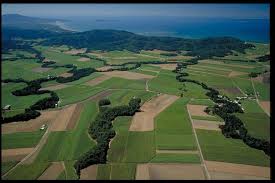
  • Many populations are fragmented.


  • Metapopulation models can be used to forecast dynamics of fragmented populations.


  • Models can be used to identify critical habitat patches or locations for establishing new subpopulations.

Origins

Richard Levins

First metapopulation models were parameterized in terms of the proportion of patches occupied.


Modern models are formulated in terms of patch-specific site occupancy or abundance.

Abundance models

Abundance formulation

A simple case with only three subpopulations

\[ N_t = n_{1,t} + n_{2,t} + n_{3,t} \]
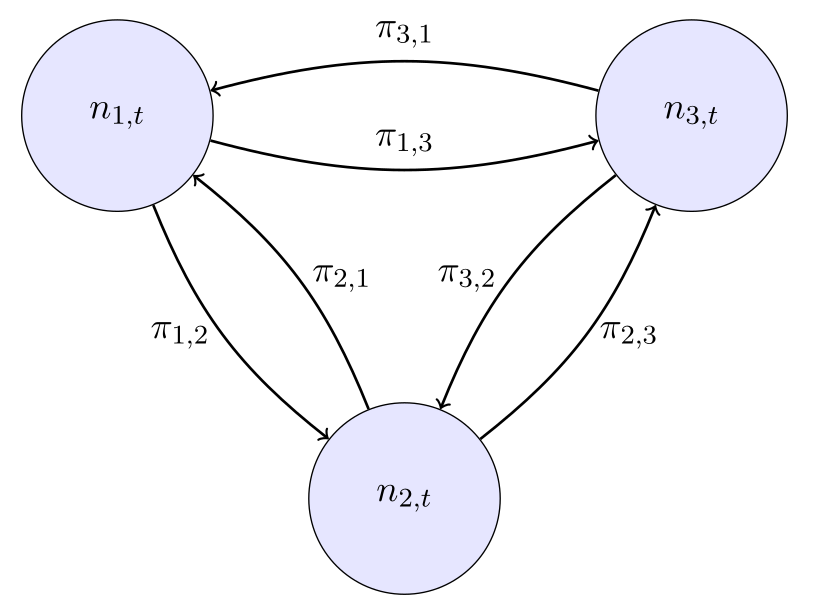
The movement probabilities (\(\pi_{i,j}\)) indicate the proportion of individuals moving from patch \(i\) to patch \(j\).

Abundance models

Building the metapopulation model for the first subpopulation.

\[ n_{1,t+1} = n_{1,t}\lambda_1 \phantom{\color{blue}{(1 - \pi_{1,2} - \pi_{1,3})} + {\color{red}{n_{2,t}\lambda_2 (\pi_{2,1}) + n_{3,t}\lambda_3 (\pi_{3,1})}}} \]

\[ n_{1,t+1} = n_{1,t}\lambda_1 \color{blue}{(1 - \pi_{1,2} - \pi_{1,3})} \phantom{+ {\color{red}{n_{2,t}\lambda_2 (\pi_{2,1}) + n_{3,t}\lambda_3 (\pi_{3,1})}}} \]

\[ n_{1,t+1} = n_{1,t}\lambda_1 \color{blue}{(1 - \pi_{1,2} - \pi_{1,3})} + {\color{red}{n_{2,t}\lambda_2 (\pi_{2,1}) + n_{3,t}\lambda_3 (\pi_{3,1})}} \]

Three components:

  1. Geometric growth
  1. 1 minus emigration rates, Pr(not emigrating)
  1. Immigration from subpopulations 2 and 3

What influences movement?


Movement probabilities (\(\pi_{i,j}\)) can be influenced by many factors:

  • Habitat quality in the patch of origin
  • Habitat quality in the landscape between origin and destination patches
  • Habitat quality in the destination patch
  • Distance between patches

Sources, sinks, and traps

Source

A patch with \(\lambda>1\) in the absence of immigration. Sources tend to be net exporters of individuals.


Sink

A patch with \(\lambda<1\) in the absence of immigration. Sinks would go extinct in the absence of immigration.


Ecological trap

A sink that animals incorrectly perceive as a high quality source.

Density and habitat quality

Can we identify sources, sinks, and traps by estimating patch-specific density (at one point in time)?
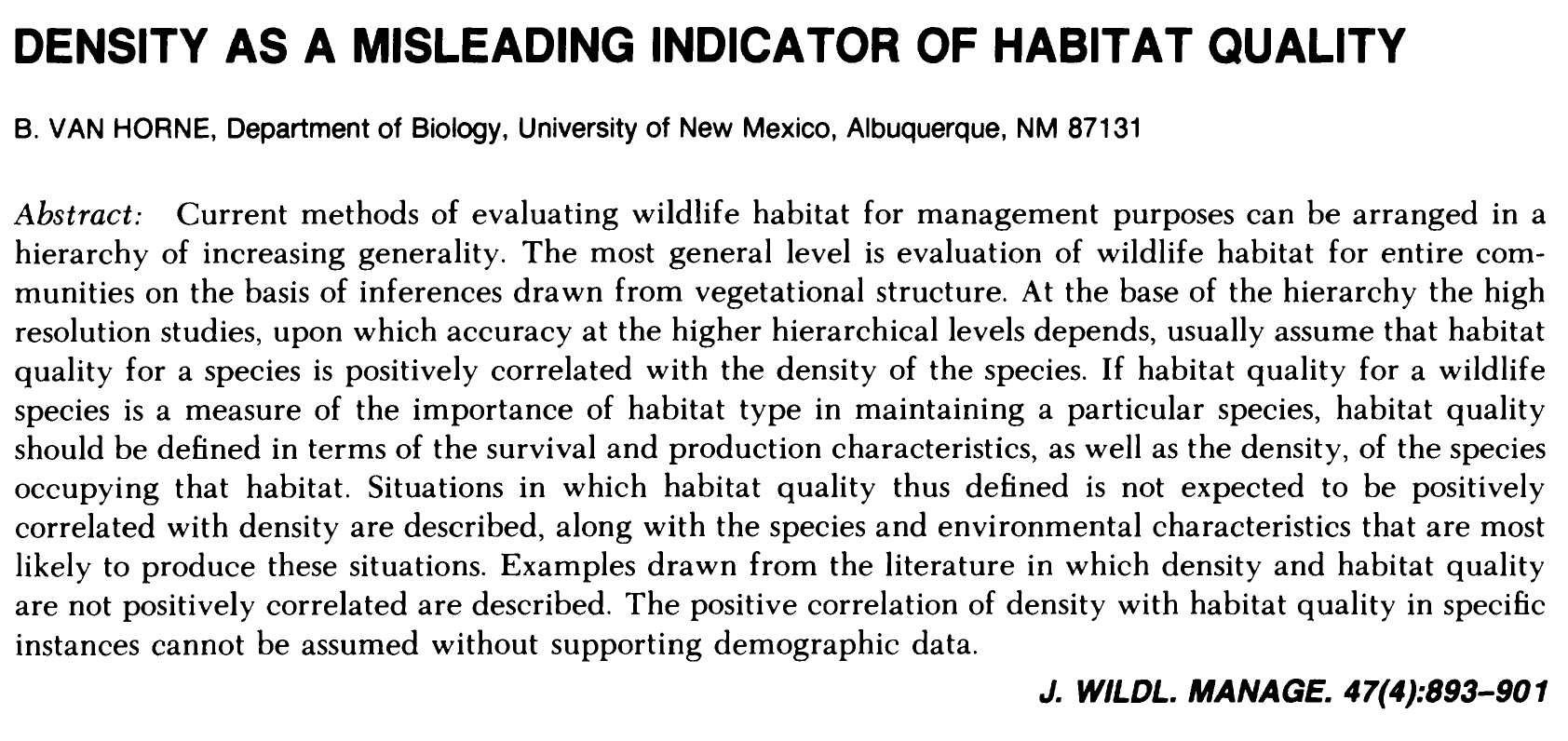
Assignment: Read this paper and be prepared to discuss it.

Occupancy models

Occupancy models


Emphasis on stochastic patch-level dynamics

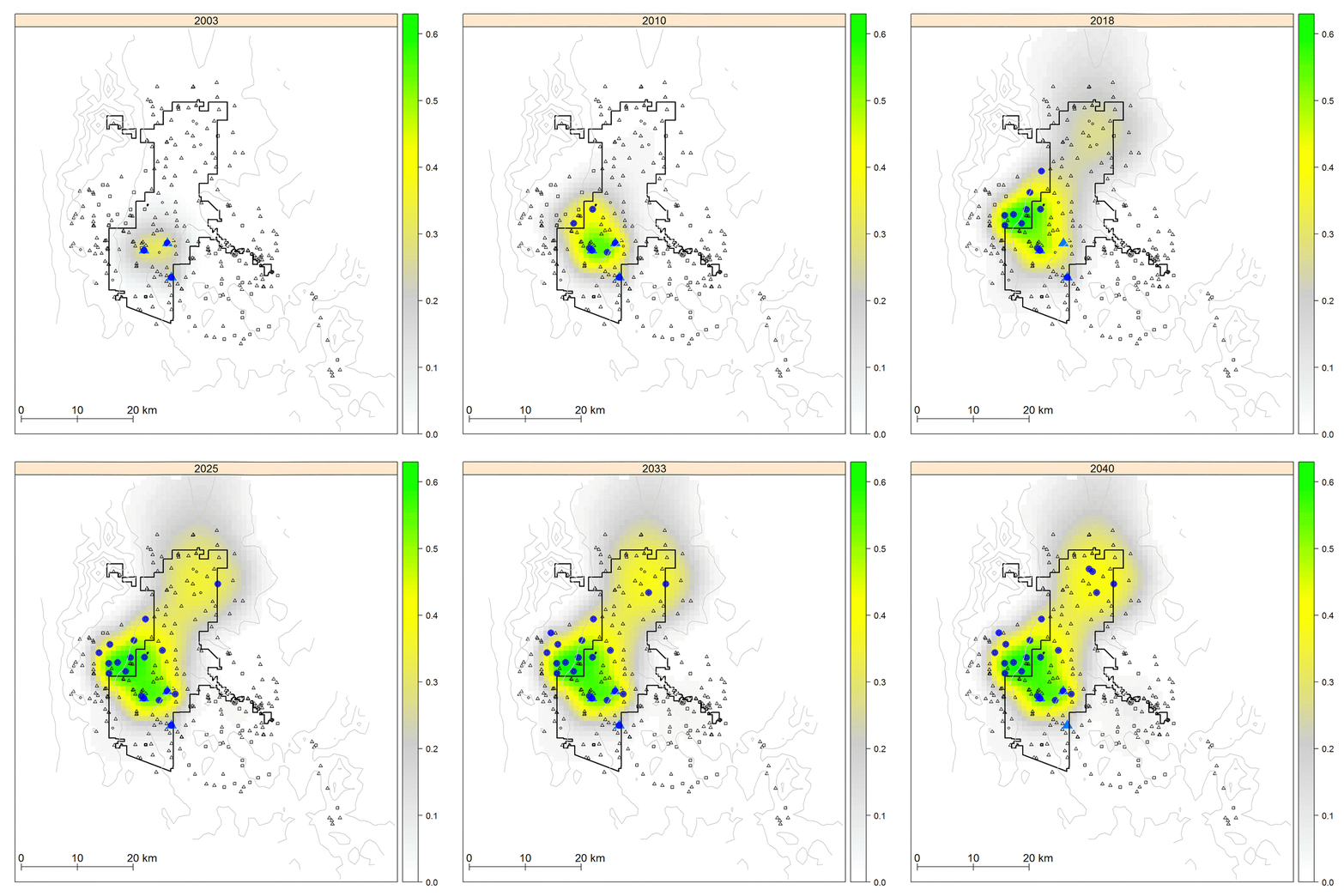
  • What is the probability that a patch will be occupied?
  • What is the probability that an empty patch will be colonized?
  • What is the probability that a subpopulation will go locally extinct?
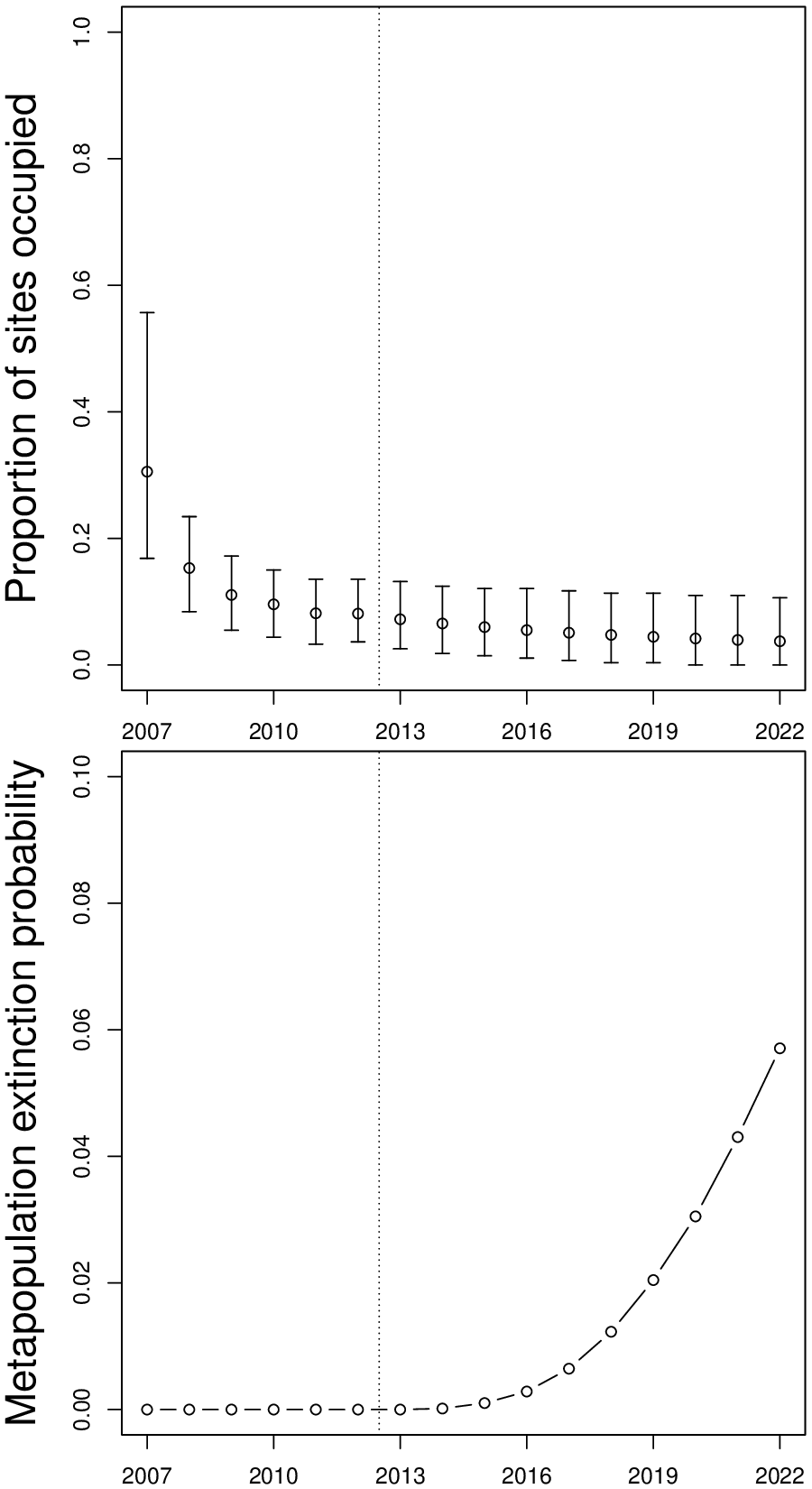
  • What is the probability that the entire metapopulation will go extinct?

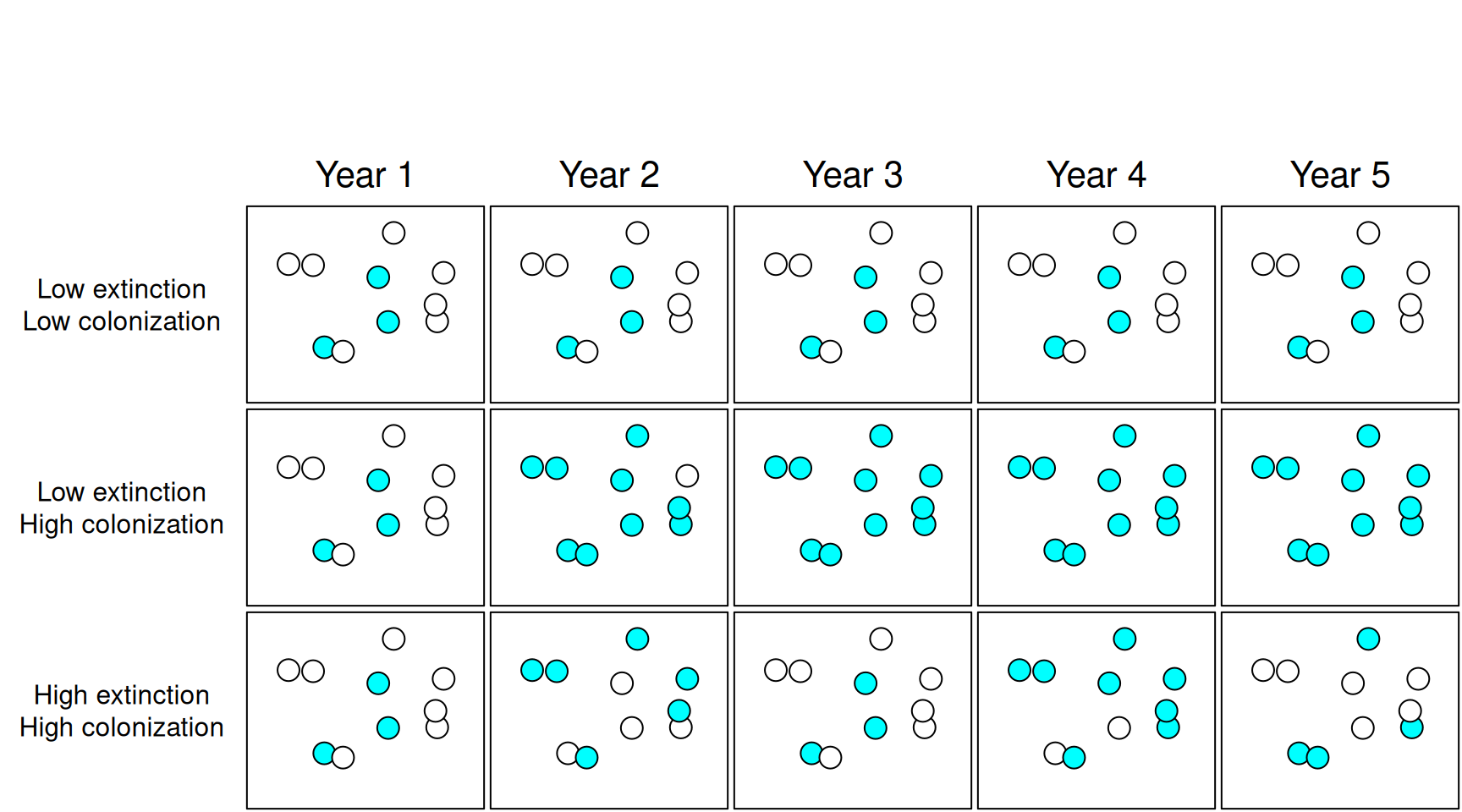
Definitions

Occurrence (\(O_{i,t}\)): Indicates if patch \(i\) occupied at time \(t\)


Occurrence probability (psi=\(\psi_{i,t}\)): Probability that site \(i\) is occupied at time \(t\)


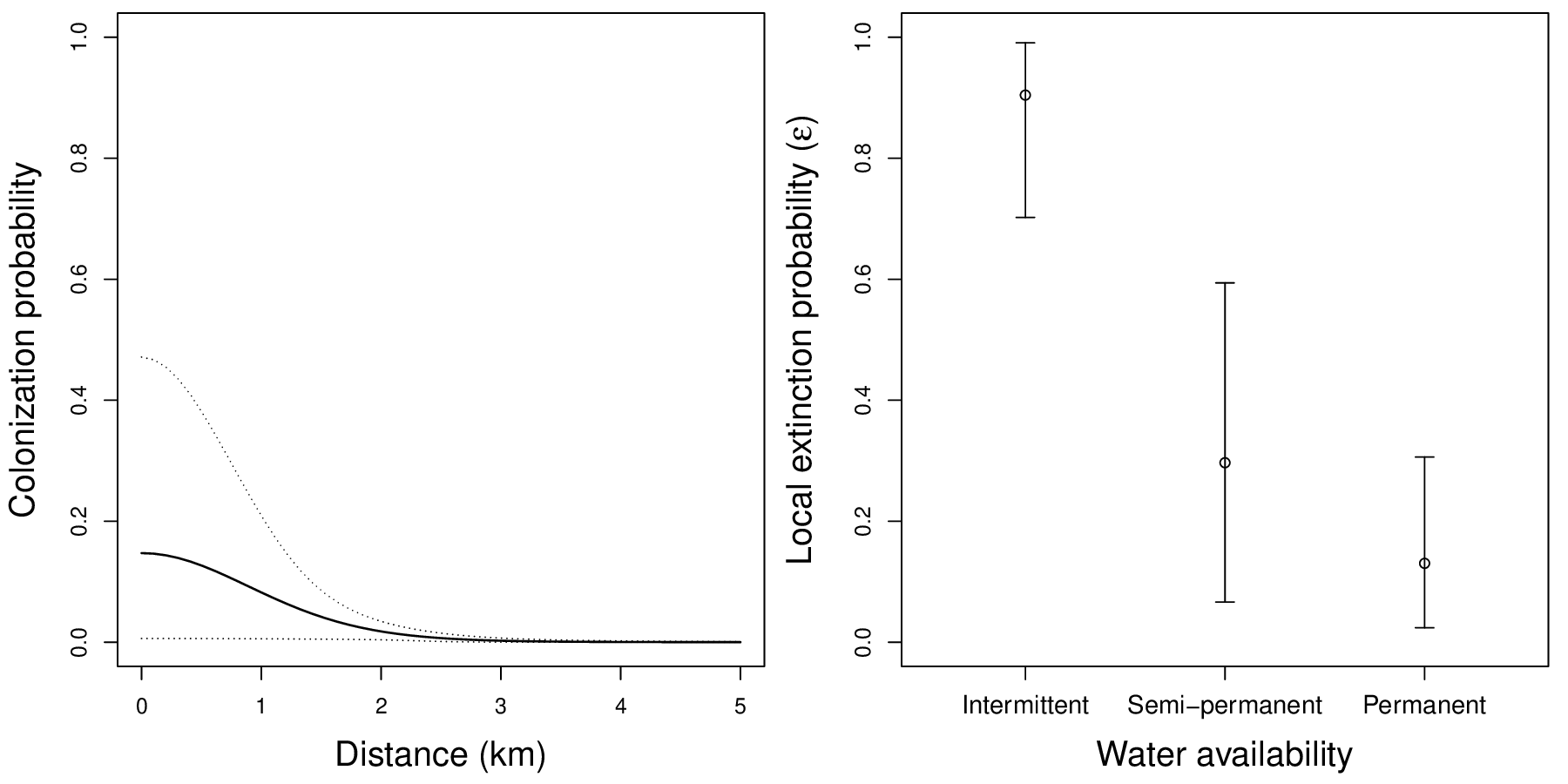
Colonization probability (gamma=\(\gamma\)): Probability that an unoccupied patch at time \(t\) becomes occupied at time \(t+1\).


Local extinction probability (epsilon=\(\varepsilon\)): Probability that an occupied patch at time \(t\) becomes unoccupied at time \(t+1\).


Metapopulation extinction risk: Probability that all subpopulation will go extinct.

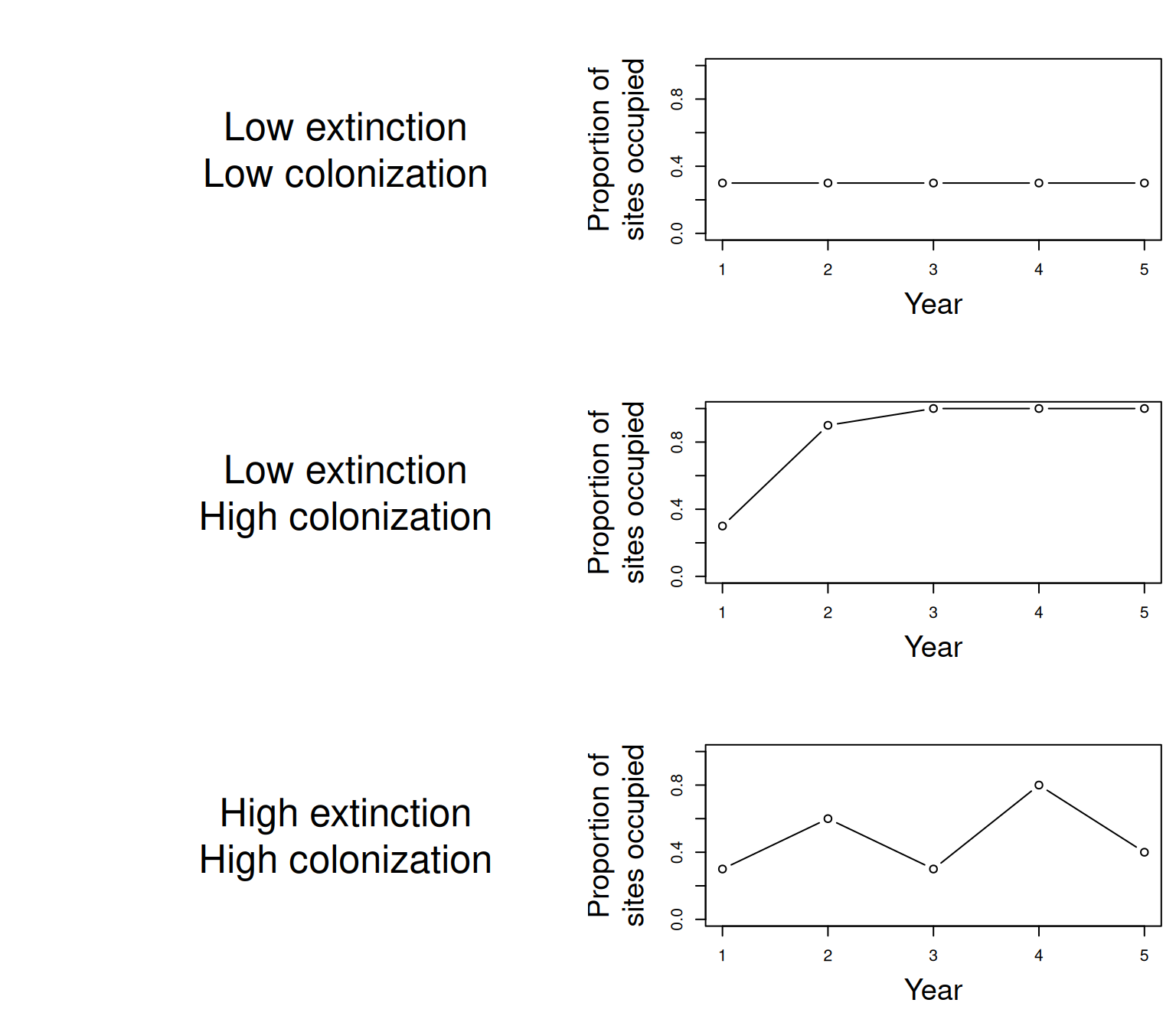
Example

Example

The model

\[ \psi_{i,t+1} = O_{i,t}(1-\varepsilon) + (1-O_{i,t})\gamma \\ O_{i,t+1} \sim \mbox{Bernoulli}(\psi_{i,t+1}) \]

  • \(O_{i,t}\)=1 if patch \(i\) is occupied at time \(t\)
  • \(O_{i,t}\)=0 if patch \(i\) is unoccupied at time \(t\)
  • \(\psi_{i,t}\) is probability that patch \(i\) will be occupied at time \(t\)
  • \(\varepsilon\) is local extinction probability
  • \(\gamma\) is colonization probability

Assumptions of basic non-spatial model

  • Abundance doesn’t matter
  • Patch quality is constant
  • Colonization and local extinction probabilities are constant
  • Landscape matrix doesn’t matter

Spatial models

Spatial models

All else equal…

  • An unoccupied site should have a higher chance of being colonized if it is close to an occupied site than if it is isolated.
  • Similarly, isolated sites should have a higher extinction probability than connected sites (rescue effect).
  • Connectivity is determined by:
    • Dispersal ability
    • Spatial configuration of sites
    • Landscape resistance to movement

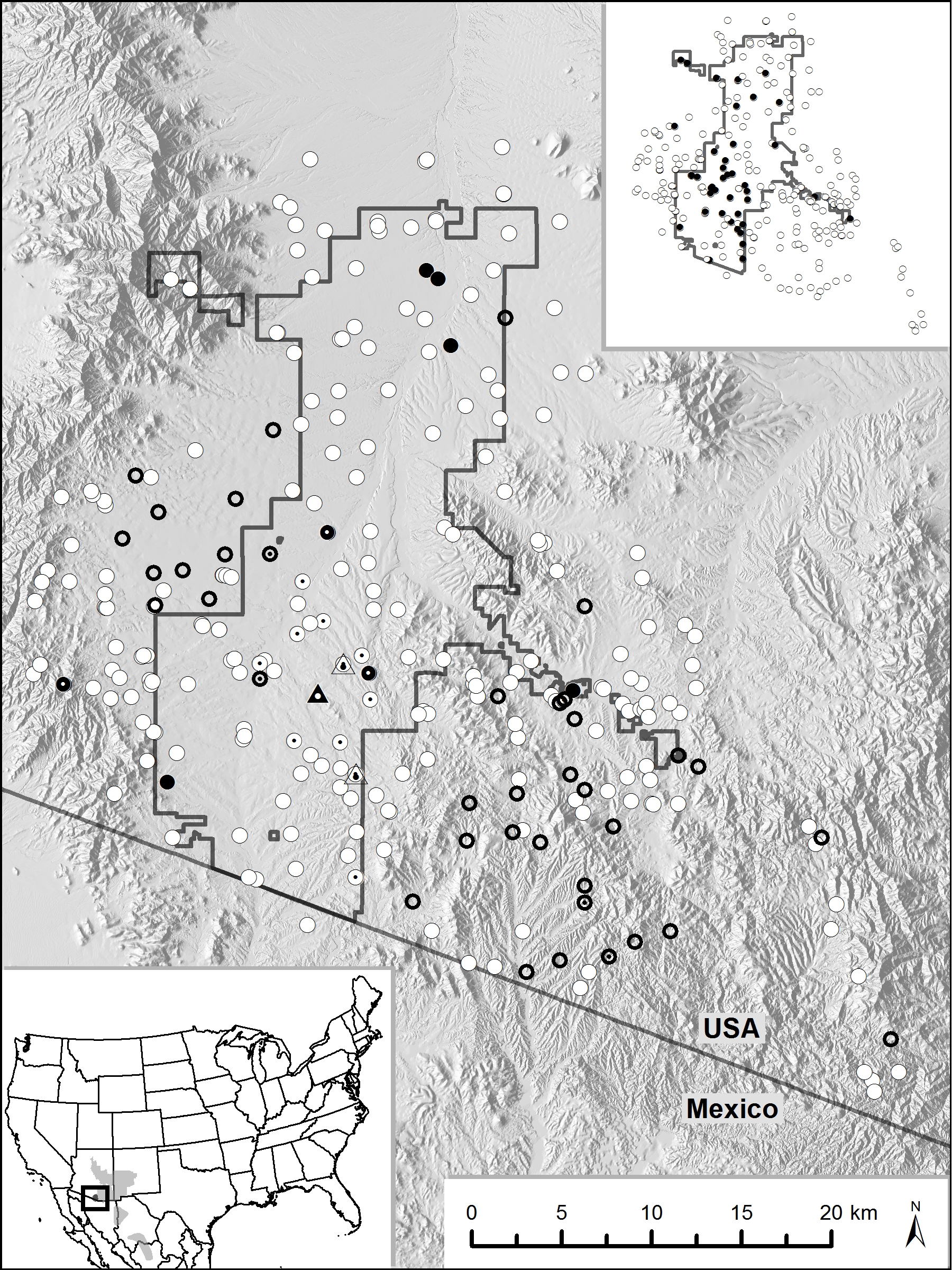
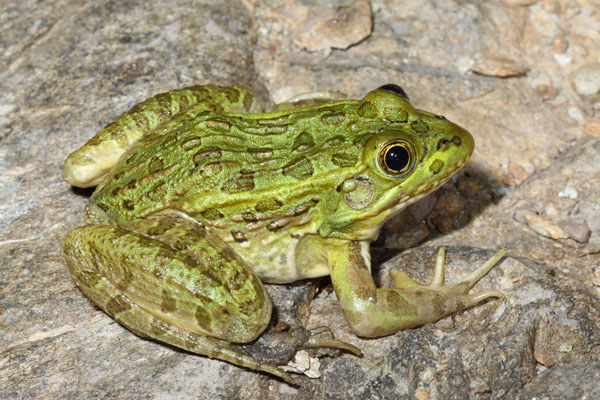
Case study


Results

Results

Results

Summary


Metapopulation models are widely used to describe the dynamics of fragmented populations.


Model can be formulated in terms of patch-level abundance or occupancy.


Modern models are stochastic and spatially explicit.